- University
- NCAD, Dublin
- Year
- 2026
- Team
- 2 people
- Duration
- 3 weeks
The Weight of Words
Hidden data.
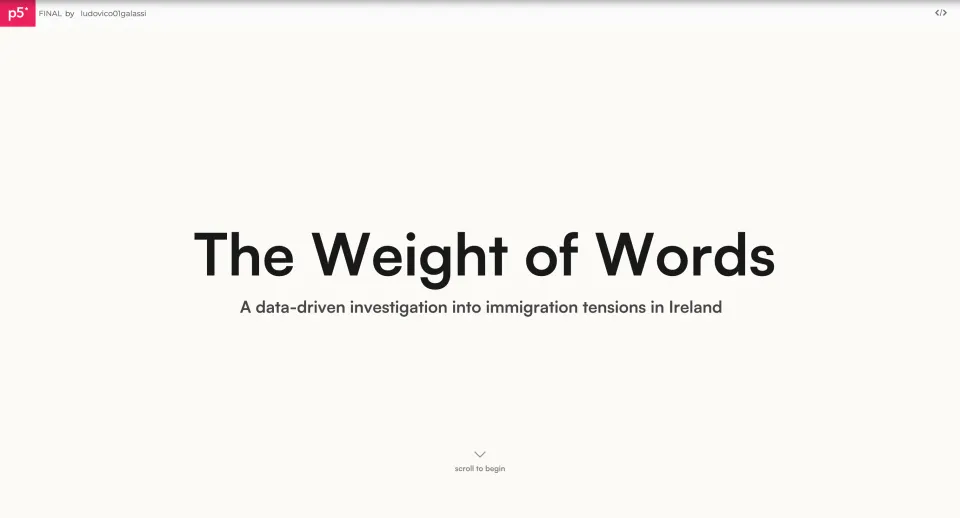
The experience, title screen
Enter the experience ↗[ In one line ]
A data-driven investigation into immigration tensions in Ireland, combining hard statistics with qualitative insights to understand how people perceive immigration and its impact.
Overview
A project about immigration, data, and contradiction.
The Weight of Words explores why immigration has become a point of social tension in Ireland, combining hard statistical data with qualitative insights gathered through interviews and surveys.
The project was developed with Rebecca Jones as part of the Hidden Data brief at the National College of Art and Design in Dublin, over a three-week period.
Starting point
Why has immigration become a point of social tension in Ireland?
Ireland is a country historically defined by emigration, yet today it finds itself struggling with the arrival of others. We wanted to understand why, and whether the public narrative around immigration reflected reality or something more complex.
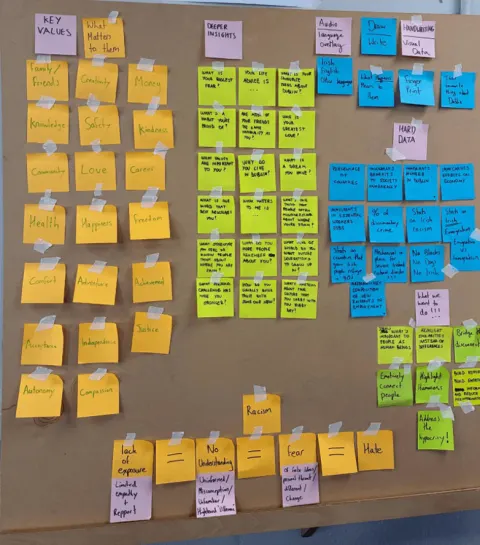
We assumed the problem was a lack of empathy.
At the start of the project, we believed Irish people lacked empathy towards immigrants. Our initial How Might We questions revolved around bridging the disconnect, highlighting humanness, and emotionally connecting people. The research proved us wrong.
Hard data
What the numbers said.
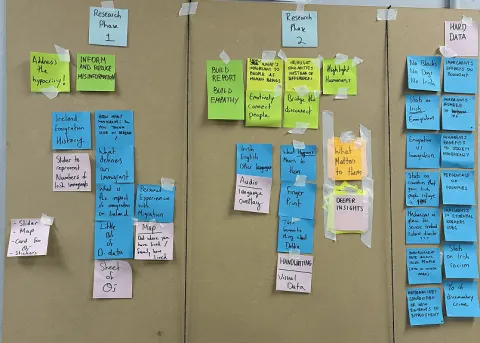
We gathered statistics across three areas that kept surfacing in public discourse. These numbers would later become the backbone of the experience.
Soft data
Research on the streets.
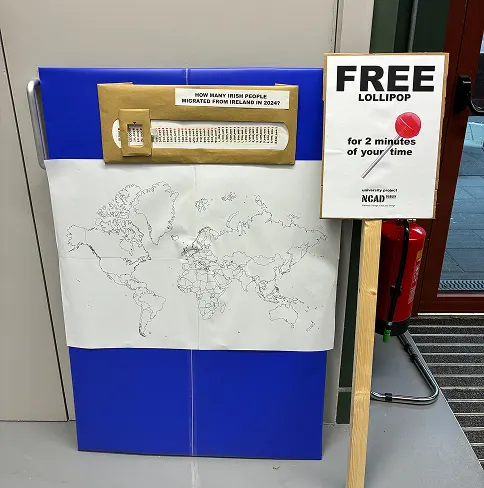
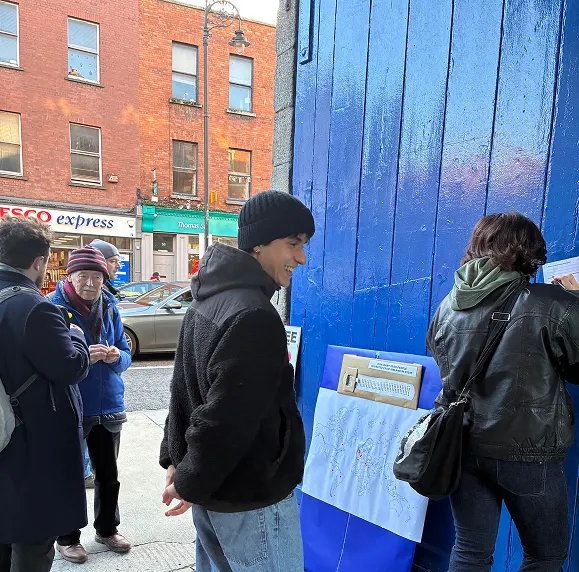
To collect qualitative data, we developed a set of three interconnected tools and carried out guerrilla testing in public spaces across Dublin, targeting Irish nationals from various demographics to capture a range of perspectives.
Research probes
- 01A number slider, where participants guessed how many Irish people emigrated in 2024 and in 1916, designed to expose the gap between public perception and reality.
- 02A world map, where participants placed a sticker on every country they had personally lived in outside Ireland, turning emigration from an abstract concept into something immediate and personal.
- 03A short questions sheet, collecting demographic information alongside open questions about how they define an immigrant, which job sectors they associate with immigration, and what impact they believe it has on Ireland.
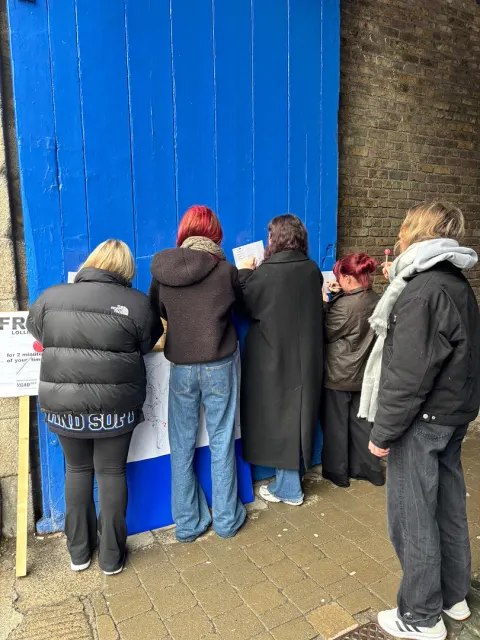
Insight
It wasn't a lack of empathy. It was contradiction.
Positive perceptions included
- +Contribution to economic and societal growth
- +Cultural enrichment (food, music, arts)
- +Increased diversity
- +Essential support for the Irish workforce
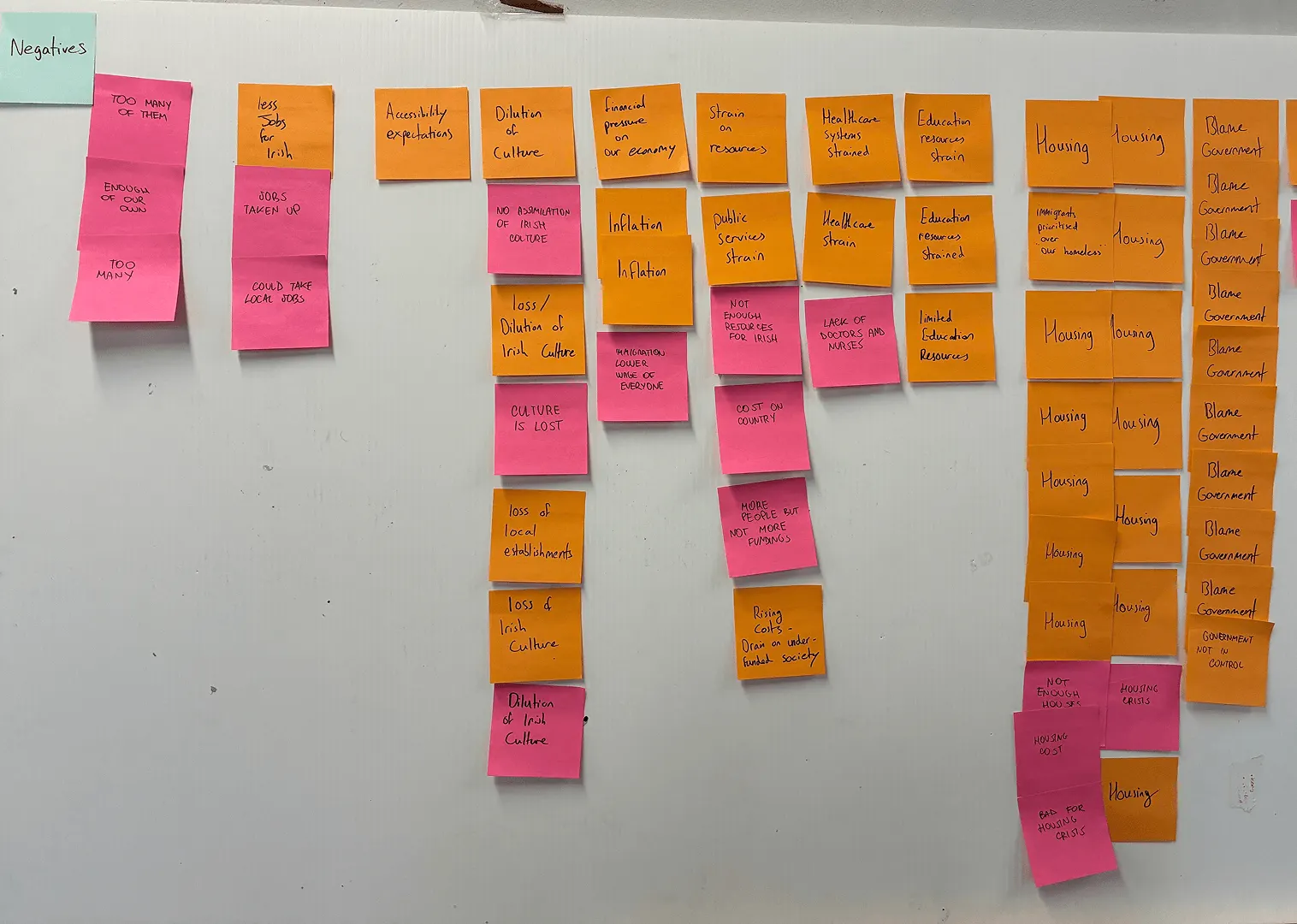
Negative perceptions included
- −Pressure on jobs and resources
- −Strain on housing and healthcare systems
- −Concerns around cultural dilution
- −Association with inflation and broader economic challenges
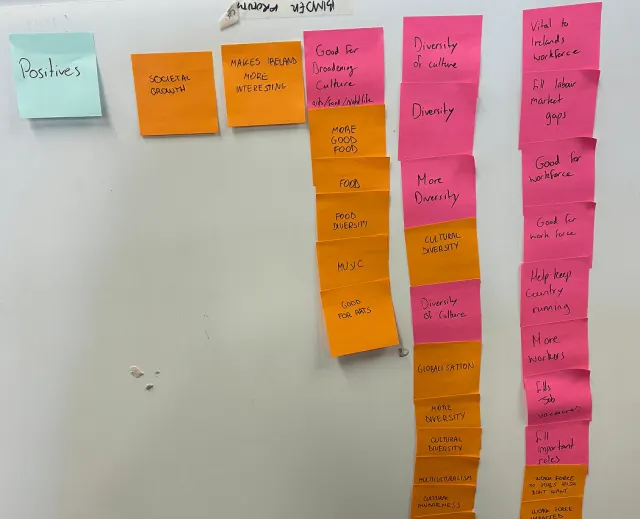
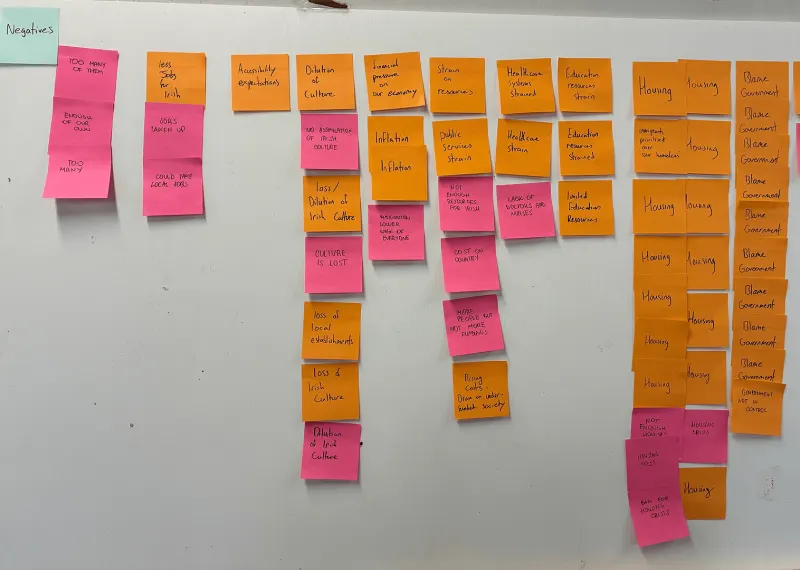
The data revealed something we hadn't anticipated: a widespread cognitive dissonance.
People describe themselves as tolerant and liberal, yet simultaneously express frustration and resentment towards immigration.
Frustration driven largely by systemic failures like housing shortages and healthcare strain, misdirected onto immigrants rather than government policy. A country shaped by centuries of emigration struggling to accept those arriving today. The project shifted entirely around this finding.
Technical implementation
Building the experience in p5.js.
The final experience was coded in p5.js, chosen for its flexibility in handling interactive data visualisation. My contribution was concentrated here, translating the narrative we had designed on paper into a fully functional digital experience, alongside the visual and graphic language of the project as a whole, from the probe design to the final presentation.

The final experience
The Weight of Words.
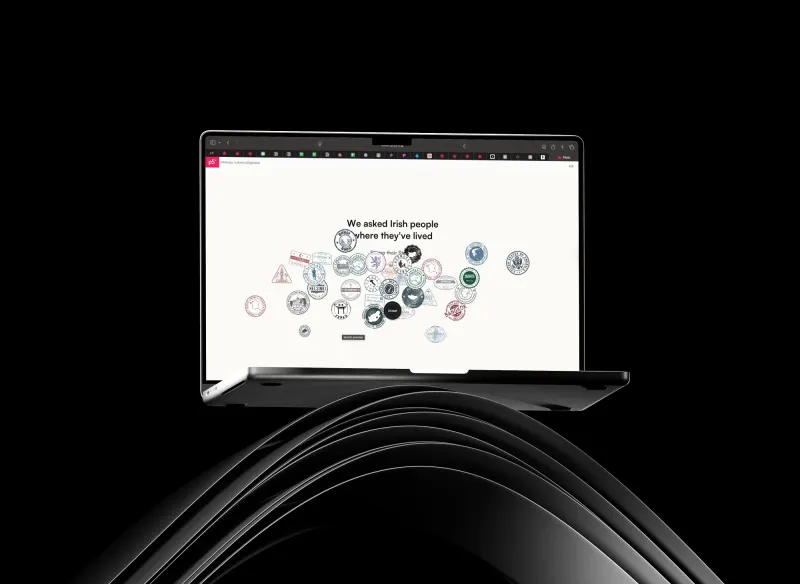
The final piece makes visible how opinions, language, and historical context interact around immigration in Ireland. Users scroll through hard data, encounter real survey responses, and are confronted with the gap between what people believe and what the numbers show.
[ In the end ]
The experience doesn't offer conclusions, it surfaces contradictions.